
Cold Chain Logistics in the UAE: What Forwarders Need to Know in 2026
The UAE has become one of the most active cold chain markets in the world, and the forwarders who understand this space are the ones winning business that others cannot handle. If you are part of the logistics network in the UAE or looking to grow into temperature-controlled cargo, 2026 is the year to get serious about it.
This is a story about infrastructure investment, tighter regulation, new technology requirements, and a market heading toward USD 2.43 billion by 2031. For independent freight forwarders, that spells real opportunity, provided you know the rules, the infrastructure, and the right partners to work with.
Here is everything X2 members and freight forwarders need to know.
How Big Is the UAE Cold Chain Market Right Now?
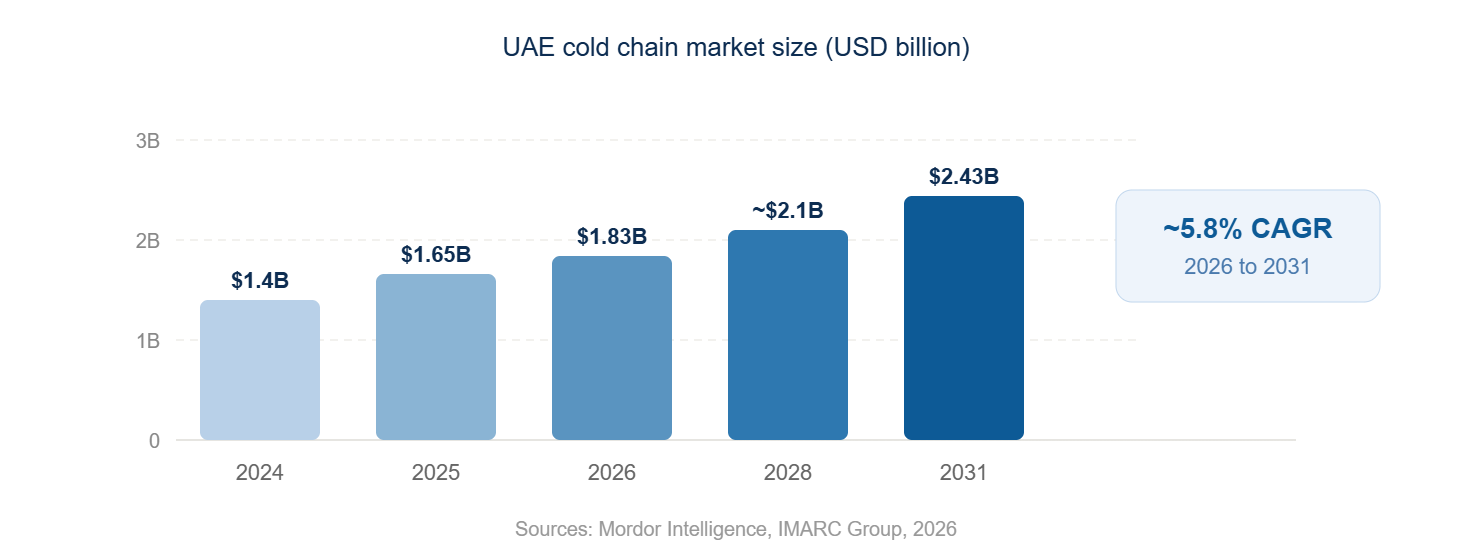
The UAE cold chain logistics market was valued at USD 1.83 billion in 2026 and is estimated to reach USD 2.43 billion by 2031, growing at a CAGR of 5.84% through the forecast period. That growth is not speculative. It is anchored in the country's pivot toward food security, pharmaceutical resilience, and a broader strategy to position its logistics sector as a regional platform rather than just a destination market.
For independent forwarders, that means sustained demand across multiple verticals: food, pharma, vaccines, speciality chemicals, cosmetics, and more. The question is whether you are positioned to serve it.
Three Forces Driving This Market
The UAE imports around 80% of its food. That is a permanent structural dependency. Emirates SkyCargo alone transports roughly 100 million kilograms of temperature-controlled pharmaceuticals annually, and approximately 80% of the UAE's agricultural products are imported. Every pallet of fresh produce, every box of dairy, every frozen seafood shipment needs uninterrupted cold chain from origin to shelf. There is no shrinking this demand.
Pharmaceutical and biotech investment has accelerated sharply. Abu Dhabi's Department of Health launched a regional vaccine distribution hub in July 2025 at KEZAD, operated by Rafed, a PureHealth subsidiary, with design capacity and processes that accommodate more than 20 vaccine types. On the air side, Emirates SkyCargo enhanced this corridor by adding Liege in January 2026 with five weekly freighter flights and reported a significant 2025 uplift in pharma throughput. The infrastructure commitment is real and it raises the compliance bar for every operator in the chain.
E-grocery is creating last-mile pressure. The frozen segment is the fastest-growing at 5.43% CAGR through 2026 to 2031, driven by e-grocery and ready-to-cook categories. Retailers and delivery platforms need cold nodes closer to consumers, faster cycle times, and multi-temperature vehicles that can handle mixed product loads in a single run. This is where a lot of the operational complexity lives.
What the Regulations Actually Require
This is where forwarders need to pay close attention, because the regulatory environment tightened meaningfully in 2025.
Federal Law No. 38 of 2024 replaced the previous UAE food safety framework. Two authorities enforce what matters on the ground:
Dubai Municipality (DM) sets and enforces temperature requirements for food products in transit and storage across Dubai. Both the temperature ranges and the documentation proving those ranges were maintained throughout the journey are subject to inspection.
Abu Dhabi Agriculture and Food Safety Authority (ADAFSA) enforces equivalent standards in Abu Dhabi and has expanded its inspection scope to include transportation vehicles, not just storage facilities.
Beyond the standard shipping documents (commercial invoice, packing list, bill of lading or airway bill, certificate of origin, trade license), cold chain shipments require additional documentation. Here is what the checklist looks like:
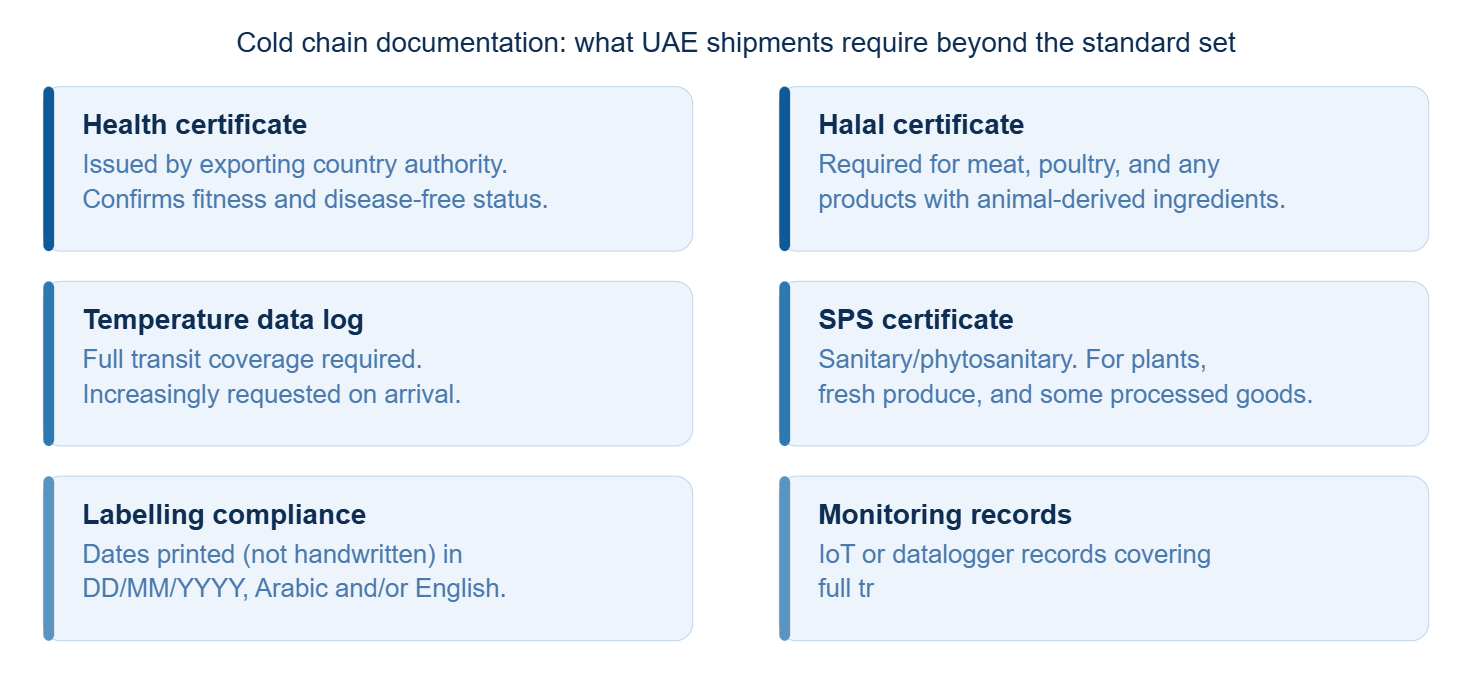
One thing that catches forwarders off guard: the UAE requires production and expiry dates to be printed, not handwritten, on packaging. Format must be DD/MM/YYYY or MM/YYYY, in Arabic, English, or both. A shipment that fails this label requirement can be rejected at the port regardless of how sound the cold chain itself was. Verify this at origin, not at the border.
Temperature Zones: Know Which Band Your Cargo Is In
The most common mistake in cold chain freight is treating "refrigerated" as a single category. Your HS code, packaging, setpoint, container type, and clearance path all change based on which band your cargo lives in. Here is how the UAE cold chain breaks down by temperature zone:
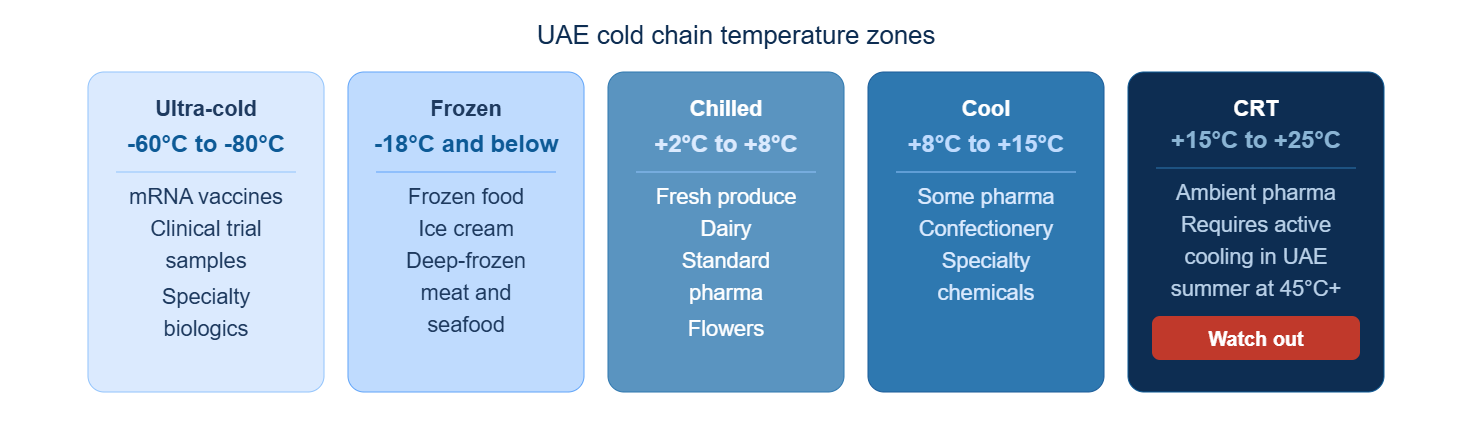
The CRT zone is where most forwarders get caught out. In most markets, Controlled Room Temperature means exactly that. In a UAE summer where outdoor temperatures regularly exceed 45C, maintaining +15C to +25C is an active refrigeration problem. Emirates SkyPharma's second zone is configured for exactly this. If your reefer equipment or your partner's vehicles are not rated for this, you have a compliance gap waiting to happen.
Key Hubs: Where the Infrastructure Actually Is
The UAE's physical cold chain infrastructure is concentrated around three major logistics zones, each offering connectivity between sea, air, and road transport.
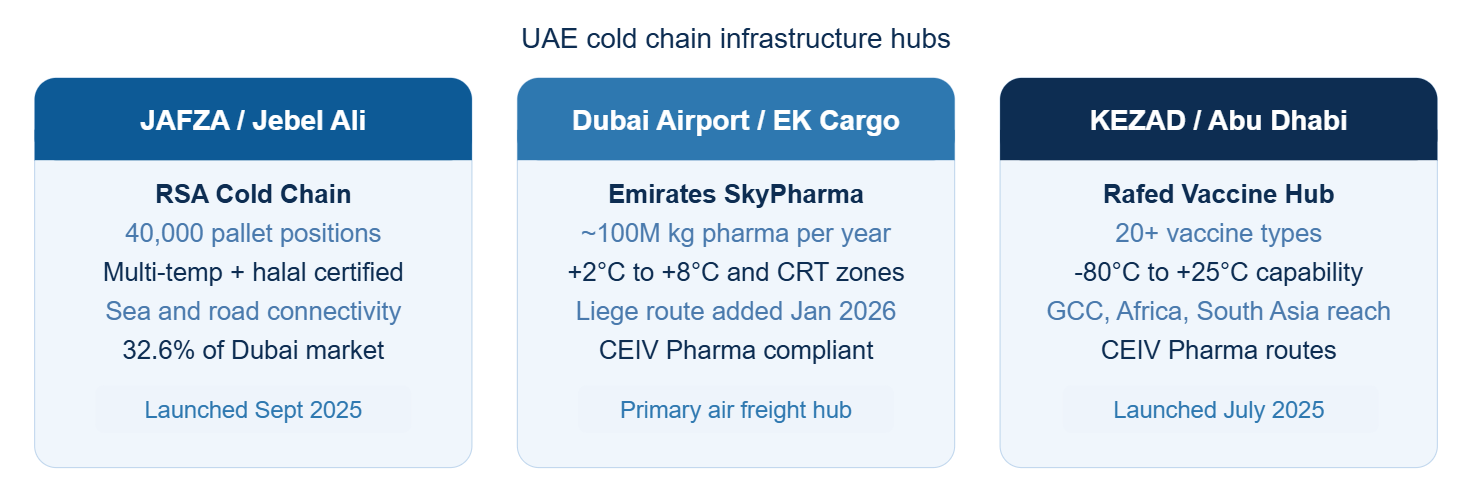
JAFZA and Jebel Ali Port remain the anchor of the UAE cold chain. RSA Cold Chain's 40,000-pallet JAFZA facility, launched in September 2025, supports halal and healthcare flows with audit-ready infrastructure. Dubai led with 32.60% of revenue in 2025 and is projected to grow at a 5.78% CAGR through 2031, driven by integrated seaport-airport networks and free-zone ecosystems.
Dubai International Airport is the region's pharma air freight nerve centre. Emirates SkyCargo transports roughly 100 million kilograms of temperature-controlled pharmaceuticals annually and has two configured zones covering standard pharma and CRT cargo.
KEZAD and Abu Dhabi Ports cover the ultra-cold end. Abu Dhabi Ports Logistics operates one of the world's most integrated pharmaceutical supply chains capable of carrying medicines at storage temperatures ranging from -80C to +25C. For forwarders handling vaccine distribution into the GCC, East Africa, or South Asia, this is the hub to know.
What Technology Now Looks Like on the Ground
Technology requirements have moved from differentiator to baseline expectation in 2026. Clients moving high-value pharma or perishables want real-time visibility as standard, not as a premium add-on.
IoT temperature monitoring is the foundation. Internet-connected sensors allow real-time monitoring of cargo conditions, providing shipment visibility throughout transit. Automated alert systems notify operators instantly if temperature variations occur, allowing corrective action before product integrity is compromised.
AI and route optimisation are gaining ground. Companies are adopting artificial intelligence and machine learning technologies to optimise storage utilisation, forecast demand, improve route planning, and enhance operational efficiency across cold chain networks. For independent forwarders, partnering with operators who already have these systems is the practical route rather than building it yourself.
Multi-temperature vehicles have become standard across UAE fleets. These trucks use movable bulkheads to create separate compartments within the same cargo hold, allowing a single vehicle to carry frozen, chilled, and ambient products simultaneously. This reduces the number of vehicles needed for mixed-product deliveries and improves operational efficiency for distributors serving diverse customers.
Sustainability is also entering procurement conversations. The growing emphasis on sustainability is encouraging investments in energy-efficient refrigeration systems, solar-powered cold storage facilities, fuel-efficient refrigerated vehicles, and environmentally responsible logistics practices. Clients, particularly in pharma and retail, are increasingly asking about your carbon footprint alongside your compliance credentials.
FAQ: What Forwarders Ask Most
What makes the logistics network in the UAE such a strong base for cold chain redistribution?
Geography is the foundation. The UAE sits between Europe, Asia, and Africa, with Jebel Ali among the world's largest ports and Dubai and Abu Dhabi airports running some of the most active pharma air corridors on the planet. The UAE's logistics ecosystem combines advanced infrastructure, regulatory efficiency, and multimodal connectivity, allowing temperature-sensitive shipments to move seamlessly across borders. That combination is genuinely hard to replicate elsewhere in the region.
What is the difference between CEIV Pharma and GDP compliance?
GDP (Good Distribution Practice) is the global standard for pharmaceutical distribution, covering storage, transport, personnel, and documentation. CEIV Pharma is IATA's certification program for airports and cargo handlers operating pharma air routes. Both are increasingly required in the UAE context. If you are quoting on pharma air freight moving through Dubai or Abu Dhabi, your handling partners should hold CEIV Pharma certification.
How should forwarders handle CRT cargo in the UAE summer months?
Pre-cool vehicles before loading. Avoid midday transfers where possible. Verify your reefer equipment is rated to maintain +15C to +25C against ambient temperatures above 45C. Failure to maintain these ranges during any part of the journey can result in product rejection, fines, or facility closure orders. This is not a risk worth taking to save on equipment costs.
Which segment is growing fastest, and why does it matter for forwarders?
Vaccines and clinical-trial materials are expanding at 6.21% CAGR through 2031, supported by Abu Dhabi's KEZAD vaccine hub and pharma air corridors. This is the highest-value, highest-compliance segment in the market. Forwarders who build relationships with partners holding ultra-cold capability are now positioning themselves ahead of demand rather than chasing it.
How does X2 Cold Chain Networks fit into this picture?
X2 Cold Chain is a leading temperature-sensitive global agent network comprised of dedicated personnel fully versed in the handling of pharmaceutical and perishable cargo. Members have access to the equipment necessary for maintaining a safe and sure delivery from origin to destination, as well as cold storage facilities to store or transit products in the supply chain cycle. As part of X2 Logistics Networks' seven specialist sub-networks, X2 Cold Chain connects independent forwarders who want to compete in this space without trying to build every capability alone. The network operates on the same principle as the broader X2 family: quality over quantity, members who are vetted, and business that stays within the group.
Putting It Together
Cold chain is not a niche vertical in the UAE anymore. It is a core part of what the logistics network in the UAE does, and the investment from government, ports, airlines, and free zones makes that very clear.
For independent freight forwarders, the opportunity is straightforward: clients moving food, pharmaceuticals, vaccines, and perishables into and through the UAE need partners who understand the compliance requirements, know the infrastructure, and can back it up with the right connections at origin and destination. That is exactly what X2 Cold Chain Networks is built around.
The market is heading toward USD 2.43 billion by 2031. The infrastructure is being built now. The forwarders who build the right knowledge and the right partnerships today are the ones who will be handling that business when it arrives.
If cold chain is a space you are growing into, or deepening your presence in, we would like to be part of that conversation. That is what the X2 community is for.