What Makes Project Cargo Different From Standard Freight Forwarding
Project cargo differs from standard freight forwarding in almost every operational sense: the cargo doesn't fit inside a container, the planning starts months or years before a single unit moves, and a single missed link in the chain can delay an entire construction or energy program rather than just one shipment. For a freight forwarder network built around specialisation, understanding that gap is exactly why project cargo gets its own dedicated discipline rather than sitting inside general forwarding.
At X2 Logistics Networks we operate seven specialised sub-networks, including X2 Projects, built specifically for members with a proven track record in breakbulk, heavy lift, and out-of-gauge cargo. This guide breaks down what actually separates project cargo from the containerised freight that makes up most of the industry's daily volume.
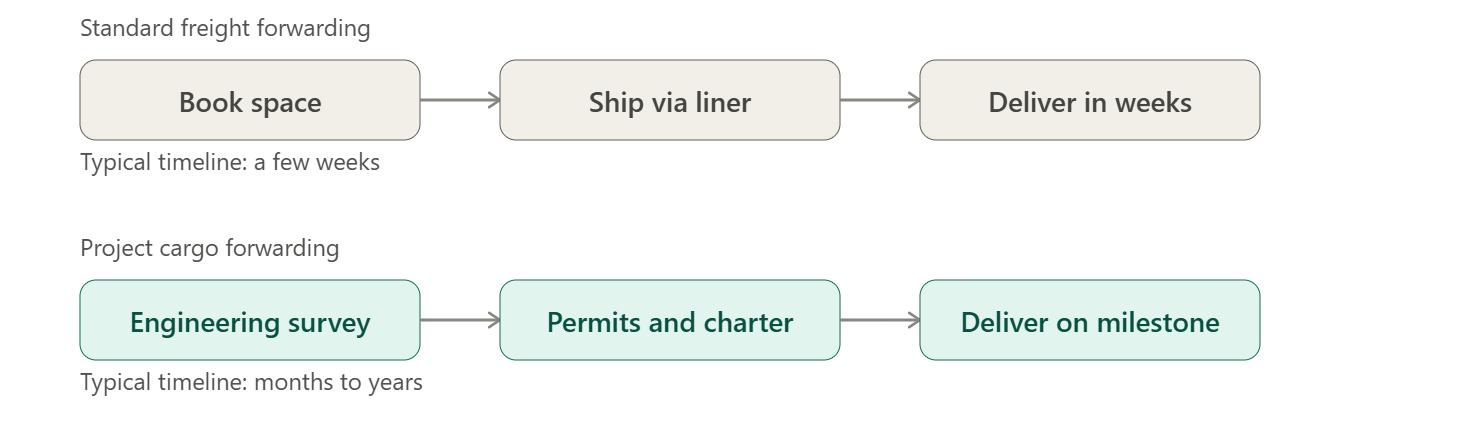
What Standard Freight Forwarding Covers:
General freight forwarding runs on recurring, largely standardised processes: booking container space on scheduled liner services, preparing a bill of lading and commercial invoice, coordinating customs clearance, and delivering on a predictable timeline. It's high-volume by design, moving everyday goods like electronics, apparel, and consumer products through the same lanes repeatedly. The skill set is coordination and consistency at scale.
What Counts as Project Cargo:
Project cargo exists specifically because some freight will never fit that model. It covers breakbulk cargo loaded piece by piece rather than in containers, heavy lift cargo generally above 100 metric tons like transformers and generators, and out-of-gauge cargo that exceeds standard container dimensions entirely, think wind turbine blades, refinery modules, or mining equipment. Many real shipments involve more than one of these categories at once, which is part of why the coordination is so different from a standard booking.
Standard vs Project Cargo, Side by Side:
| Feature | Standard freight forwarding | Project cargo forwarding |
|---|---|---|
| Cargo type | Fits standard container dimensions | Breakbulk, heavy lift, out-of-gauge |
| Vessel type | Scheduled liner container services | Breakbulk, RoRo, heavy-lift, or chartered vessels |
| Documentation | Bill of lading, commercial invoice | Adds oversize permits, road survey approvals, police escorts |
| Planning horizon | Weeks | Months to years, tied to a project's critical path |
| Equipment | Standard container handling | Cranes, modular trailers, flat racks, sometimes barges |
| Success metric | On-time, on-cost delivery | Delivery synced to a fixed construction or commissioning milestone |

How Far in Advance Project Cargo Planning Starts:
This is the detail that separates the two disciplines more than any other. Industrial and energy projects run on critical-path schedules, not freight invoices. If a transformer scheduled for week 39 arrives in week 42 instead, the construction program slips and the commercial operation date moves with it. That means project cargo forwarders are engaged long before cargo is ready to ship, often reviewing route feasibility, bridge and tunnel clearances, and port capability months or years ahead of the actual move, a discipline closer to construction logistics coordination than routine booking.
The Extra Permits and Approvals Project Cargo Requires:
Standard shipments run on a fairly fixed document set. Project cargo adds a substantially heavier layer: permits for oversized loads, safety approvals, road survey clearances, temporary road closures, and in many cases police escorts for abnormal loads moving overland. One advantage worth noting: breakbulk shipments typically require only a single bill of lading covering the whole shipment, simpler in that one respect than a containerised shipment split across many bills of lading, even as the surrounding permitting workload is far heavier.
What's Driving Higher Project Cargo Demand in 2025 and 2026:
Demand for breakbulk and project cargo capacity has been rising, driven largely by renewable energy equipment like wind turbine blades and transformers, continued urbanisation pushing construction machinery transport, and infrastructure and energy investment across emerging markets in Africa, Southeast Asia, and Latin America. As specialised heavy-lift vessel demand climbs alongside it, the forwarders with genuine project cargo experience, not general capacity, are the ones best positioned to handle it.
How a Freight Forwarder Network Reduces Project Cargo Risk:
For general cargo, a strong local presence at origin and destination is valuable. For project cargo, it's close to essential. A single project shipment often depends on route surveys, port capability, and equipment availability that only an experienced, vetted partner on the ground can confirm reliably. That's precisely the gap a dedicated freight forwarder network like X2 Projects is built to close, connecting forwarders with a demonstrated track record in out-of-gauge, oversize, and overweight cargo, rather than leaving members to vet unfamiliar agents shipment by shipment on complex moves where a single wrong assumption about road clearance or port capacity can derail a project timeline.
X2 Projects Members' Track Record in Breakbulk and Heavy Lift:
Members within our X2 Projects network have proven expertise in breakbulk, charter, and barge operations, backed by the resources needed to handle commercial, military, and government-scale project cargo. That specialisation matters because project cargo forwarding isn't a general capability that scales down from container freight; it's a distinct discipline built around engineering assessment, contracting for specialised vessel or trailer capacity, and execution under fixed milestones.
Four Signs Your Business Is a Fit for Project Cargo:
A few questions tend to clarify whether a shipment, or a forwarder's growth strategy, belongs in project cargo: Does any single piece of cargo fall outside standard container dimensions? Does the move require charter vessel capacity rather than liner space? Is delivery tied to a fixed construction or commissioning milestone? Is the destination remote or infrastructure-constrained? Forwarders answering yes to several of these regularly are the ones who benefit most from a dedicated project cargo network rather than relying on general freight connections.

Grow Your Project Cargo Business With X2:
If your business has a track record in breakbulk, heavy lift, or out-of-gauge cargo and you're looking to expand through trusted, vetted partnerships worldwide, X2 Projects connects you with forwarders who understand exactly what this discipline demands. Get in touch to learn more about joining our freight forwarder network.
FAQs
What's the main difference between project cargo and standard freight forwarding?
Project cargo involves breakbulk, heavy lift, or out-of-gauge freight that doesn't fit standard containers, requiring months or years of advance planning tied to a fixed project schedule, compared to the weeks-long, repeatable process of standard container freight.
What counts as out-of-gauge cargo?
Cargo exceeding standard container dimensions, generally longer than 40 feet, wider or higher than 14 feet, or heavier than roughly 30 metric tons, depending on the carrier's specific thresholds.
Why does project cargo need more documentation than standard freight?
Beyond the standard bill of lading and commercial invoice, project cargo often requires oversize permits, road survey approvals, safety clearances, and police escorts for abnormal overland loads.
Why join a specialized freight forwarder network for project cargo?
Project cargo depends heavily on verified local capability, route feasibility, port equipment, and vessel access, that a general network can't reliably guarantee. A dedicated network vets members specifically for this track record.
Is demand for project cargo forwarding growing?
Yes. Renewable energy equipment, infrastructure investment in emerging markets, and continued urbanization have driven rising demand for breakbulk and heavy-lift capacity in 2025 and 2026.