How Freight Forwarder Networks Help Independent Agencies Compete With Multinationals
An independent freight forwarder competing alone against DHL, Kuehne + Nagel, or DB Schenker is competing without the infrastructure those giants spent decades building. Join a freight forwarder network, and that calculus changes: pooled buying power, pre-vetted local partners in markets you don't cover yourself, and the reach to quote door-to-door service anywhere in the world, all while keeping your name, your client relationships, and your independence intact.
At X2 Logistics Networks we've built exactly this model across seven specialized sub-networks, X2 Elite, X2 Critical, X2 Asia Global, X2 Projects, X2 Consolidators, X2 Movers, and X2 Cold Chain, connecting more than 1,000 vetted members across 150+ countries. Here's how that structure actually helps an independent agency compete on equal footing with the multinationals.
What Multinationals Have That Independents Usually Don't:
Meeting today's client expectations, fast transit times, real-time tracking, competitive pricing, multimodal coverage, is difficult for an independent company without global infrastructure. A logistics network exists specifically to bridge that gap, giving independent forwarders access to the tools, coverage, and partnerships needed to compete at the scale and efficiency of a multinational, without needing to build that infrastructure themselves.
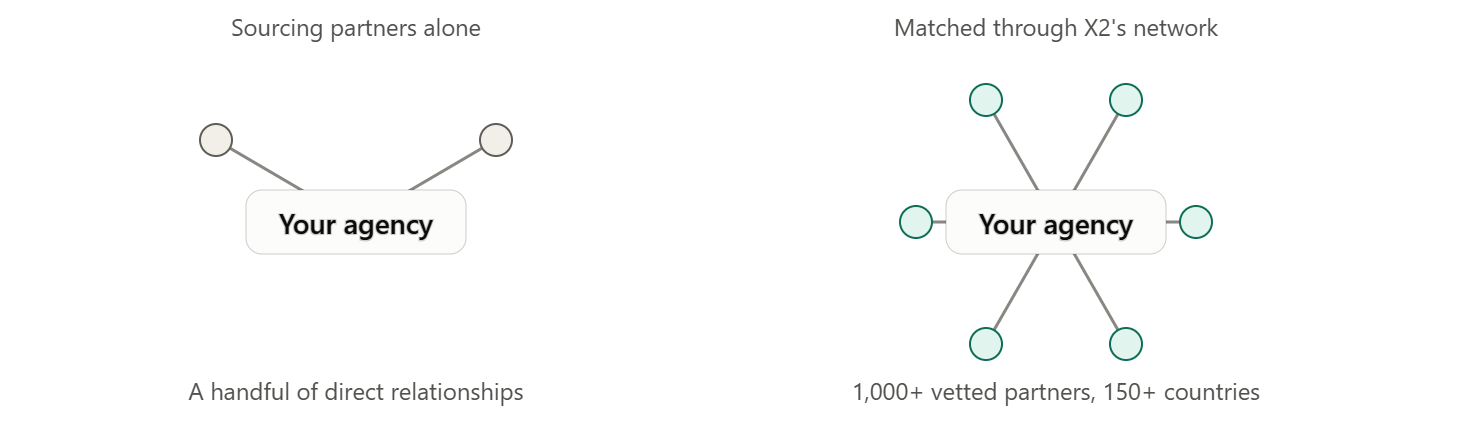
Alt text: Two hub-and-spoke diagrams side by side. On the left, an agency sourcing partners alone connects to only two direct relationships. On the right, the same agency matched through X2's network connects to six-plus vetted partners, representing over 1,000 members across 150+ countries.
How Pooled Cargo Volume Improves Carrier Rates:
Collaboration with reliable partners lets independent agencies quote door-to-door services and secure better carrier rates through collective buying power, the same leverage multinationals get from sheer volume. As collaboration across a network increases cargo volume, it generates real rate advantages with carriers, which in turn attracts more members and more volume, a compounding effect that no single independent agency can replicate on its own.
How Member Vetting Removes the Unknown-Agent Risk:
Working with an unfamiliar agent in a foreign market is one of the biggest risks in freight forwarding, and it's a risk multinationals largely design around through owned offices. Independent agencies don't have that luxury unless they're part of a network that pre-vets every member. A well-run network only admits companies with a demonstrated track record of reliability and operational excellence, which means members work with partners they can trust from day one, rather than gambling on an unknown agent for every new lane.
Independent Alone vs. Network-Backed vs. Multinational:
| Feature | Independent, unaffiliated | Network-backed independent | Multinational |
|---|---|---|---|
| Global reach | Limited to owned relationships | Broad, via vetted network partners | Owned offices worldwide |
| Carrier rates | Standard, low volume | Improved via collective volume | Best-in-class, high volume |
| Local expertise | Deep, but only where you operate | Deep everywhere via local members | Variable, often generalized |
| Client relationship | Direct, personal | Direct, personal | Often routed through account managers |
| Financial risk on new agents | High | Reduced via vetting and protection plans | Low, internal offices |
| Flexibility for niche cargo | High, but limited reach | High, with global reach | Lower, standardized processes |

Why Payment Protection Plans Reduce Network Risk:
Beyond operational coordination, established networks typically offer payment protection plans that reduce financial risk when working with partners abroad, a meaningful safeguard for independent agencies that don't have the balance sheet of a multinational absorbing a bad debt. Combined with annual in-person meetings that build the trust digital communication alone can't fully replicate, this is part of what makes network membership a financial decision, not just an operational one.
Why Specialized Sub-Networks Outperform One Generalized Membership:
Trying to compete with global leaders across every vertical isn't realistic for an independent agency. The stronger strategy is becoming the best in specific niches where personalized expertise matters more than raw scale, whether that's reefer logistics, dangerous goods, or project cargo. This is precisely why X2 Logistics Networks is structured around seven specialized sub-networks rather than one generalized membership. An agency strong in cold chain logistics gets matched with X2 Cold Chain members who understand that discipline specifically, while a project cargo specialist connects through X2 Projects, rather than being pooled indiscriminately with generalist forwarders across unrelated cargo types.
How Shipment-Tracking Technology Has Leveled the Field:
It's worth noting that shipment visibility, cargo tracking, and digital documentation, capabilities once associated primarily with large multinational providers, are now broadly accessible across the industry. That narrows one of the multinationals' traditional advantages considerably, which means the remaining differentiators, trusted local partners, specialized expertise, and personal client relationships, matter more than ever. Networks amplify exactly those strengths rather than trying to out-scale the giants on infrastructure alone.
What Clients Actually Hear When You Say "We Cover That Route":
When a client asks whether you can move cargo from Shanghai to Santiago, or coordinate a specialized project shipment across three continents, the honest answer for a network member is yes, through trusted partners who operate under the same standards you do. That reassurance, delivered by someone the client already has a direct relationship with, is often what tips a decision in an independent agency's favor over a multinational offering the same route through a rotating account manager.

Join a Freight Forwarder Network Built on Specialization:
If your agency has a proven track record and you're ready to compete globally without losing your independence, X2 Logistics Networks connects you with vetted partners across seven specialized disciplines, from general cargo to cold chain to project logistics. Get in touch to learn more about joining our freight forwarder network.
Frequently Asked Questions
How does joining a freight forwarder network help an independent agency compete with multinationals?
It provides access to vetted local partners worldwide, collective carrier buying power, and financial protection, the same core advantages multinationals get from owned global infrastructure, without requiring an independent agency to build that infrastructure itself.
Do I lose my independence by joining a freight forwarder network?
No. Members keep their own brand, direct client relationships, and operational independence. The network provides connections and collective resources, not ownership or control.
What's the benefit of a specialized sub-network like X2 Projects or X2 Cold Chain?
It matches you with partners who have proven expertise in your specific cargo discipline, rather than a general pool of forwarders, which matters especially for complex cargo like project logistics or temperature-sensitive shipments.
How do networks reduce the risk of working with unfamiliar overseas agents?
Reputable networks pre-vet every member for reliability, financial standing, and operational track record before admission, removing much of the guesswork of finding a trustworthy partner in a new market.
Is technology still a major advantage multinationals have over independents?
Less than it used to be. Shipment tracking, digital documentation, and real-time visibility tools are now widely accessible across the industry, narrowing that historical gap considerably.